You’ll read dozens of guides about Houmt Souk that all tell you the same thing: “stroll through the colorful souk”, “visit the fortress”, “admire local craftsmanship”. Great. Except these guides forget to tell you what’s essential.
After five years living in Djerba, I’m going to explain how Houmt Souk actually works. Not the postcard version. The practical version. The one that keeps you from driving in circles for 45 minutes looking for parking, paying three times the normal price at the souk, or arriving at noon right when everything closes.
Houmt Souk is the beating heart of Djerba. Administrative capital, shopping center, fishing port — everything happens here. But navigating this city requires a few codes that nobody ever explains to you. Until now.
The Hidden History Behind the Name (Understand It to Live It Better)
“Houmt Souk” literally means “market district”. Sounds simple, but it explains everything.
This city developed on the ruins of Gerba (or Girba), a Roman city that saw the birth of two emperors: Trebonian Gallus and his son Volusian. It was actually this ancient city that gave its name to the entire island of Djerba.
But unlike typical Mediterranean cities with their fortified medinas, Houmt Souk was built around one precise function: commerce. For centuries, merchants from across the Mediterranean basin, from Africa and the Middle East converged here to trade. The souk wasn’t an addition — it was the city’s reason for being.
This commercial history explains why Houmt Souk looks like no other Tunisian city. No single central square, but a maze of commercial alleys. No compact souk, but specialized zones spreading across several sectors. Weavers here, jewelers there, blacksmiths elsewhere.
The city is divided into four historical sectors: Taourit and Essouani in the north, Boumellel and Ejjouamaâ in the south. The commercial center straddles all four. Understanding this organization helps you navigate — though let’s be honest, you’ll still get lost at first.
The Borj El Kebir fortress you see by the water? Built in the 13th century on Roman ruins, remodeled a hundred times, occupied by the Spanish, reclaimed by Ottoman corsair Dragut after the famous naval battle of 1560. It’s from this battle that the sinister Tower of Skulls (Borj er Rouss) came — a pyramid of 6000 skulls that was fortunately destroyed in 1848.
All this to tell you: Houmt Souk isn’t a stage set. It’s a living city, built layer by layer, where every alley tells centuries of commerce, battles, and cultural exchanges.


The Djerbian Rhythm: What the Guides Don’t Tell You
The business hours on Google Maps for Houmt Souk? Take them as vague suggestions, not as gospel truth.
Djerbian reality works differently. Here’s how it actually works.
**Businesses**
Morning: 8am-1pm maximum
The souk comes alive at 8am. Vendors set up their stalls, locals do their morning shopping. It’s the best time — fewer crowds, bearable temperatures, fresh market produce.
Noon-4pm: The city stops
Around 1pm, everything starts to close. By 1:30pm, Houmt Souk looks like a ghost town. It’s siesta time. Non-negotiable. Shops lower their shutters, restaurateurs sleep, even the cats find shade.
Don’t get frustrated if you arrive at 12:30pm and vendors are already packing up. You’re late by their clock.
Late afternoon: 4pm-7pm
Some shops reopen around 4pm-4:30pm, but not all. It’s random. Tourist-oriented souk boutiques reopen more consistently. Local businesses (bakeries, corner stores) sometimes stay closed.
Evening: After 7pm
Cafés and restaurants come alive. The corniche becomes where families take their evening stroll. But souk shops are generally closed.


**Markets**
Thursday morning: The big tourist market
All guides mention it. Busy market, lots of activity, but also lots of tourists and vendors inflating prices.
Monday morning: The “local color” market
The one tour operators skip because it’s “too popular”. Exactly why you should go. More authentic, more reasonable prices, local atmosphere.
Sunday afternoon: Secondary market
Less crowded, worth checking out if you want peace and quiet.
Fish market: Every day 10am-1pm
The auction hits its peak around 10:30am-11am. Arrive before noon if you want to see something. After that, it’s over.
**My timing recommendation**
Want to avoid crowds? Come weekdays (Tuesday-Wednesday), early morning (8am-10am).
Like the atmosphere? Thursday or Monday morning, but accept there will be crowds.
Just want to stroll peacefully? Late afternoon weekdays (5pm-6:30pm), beautiful light, pleasant temperatures, fewer hassles.


Parking at Houmt Souk Without Driving in Circles for 45 Minutes
**Free local parking spots**
Port/marina parking: Large, free, rarely full. 10 minutes walking from the souk center. My favorite.
Around the Sidi Zayed Mosque: A few spots along the corniche. Arrive early.
Behind the central market: Small impromptu parking that few tourists know about. Follow the locals.
Habib Thameur Avenue (north side): Spots along the avenue, free, 5-7 minutes walking from the souk.
**Mistakes to avoid**
DON’T park in the tiny souk alleys. You risk blocking traffic and getting yelled at (politely, but still).
DON’T leave anything visible in your car. Theft is rare, but temptations are there.
If someone offers to “watch your car”, understand they expect 1-2 TND tip when you return. It’s unofficial but very common. Accept or politely decline right away.
**The clever alternative**
Leave your car at your hotel and take a taxi. From the tourist zone (Midoun), it’s 8-10 TND. Zero parking stress, zero hassle. The taxi drops you right at the souk.


The Souk: Tourist Version vs Djerbian Version
The Houmt Souk souk spans several kilometers. But there’s the souk where tourists go, and the one where Djerbians go. They overlap without really mixing.
**The tourist souk (Central covered souks)**
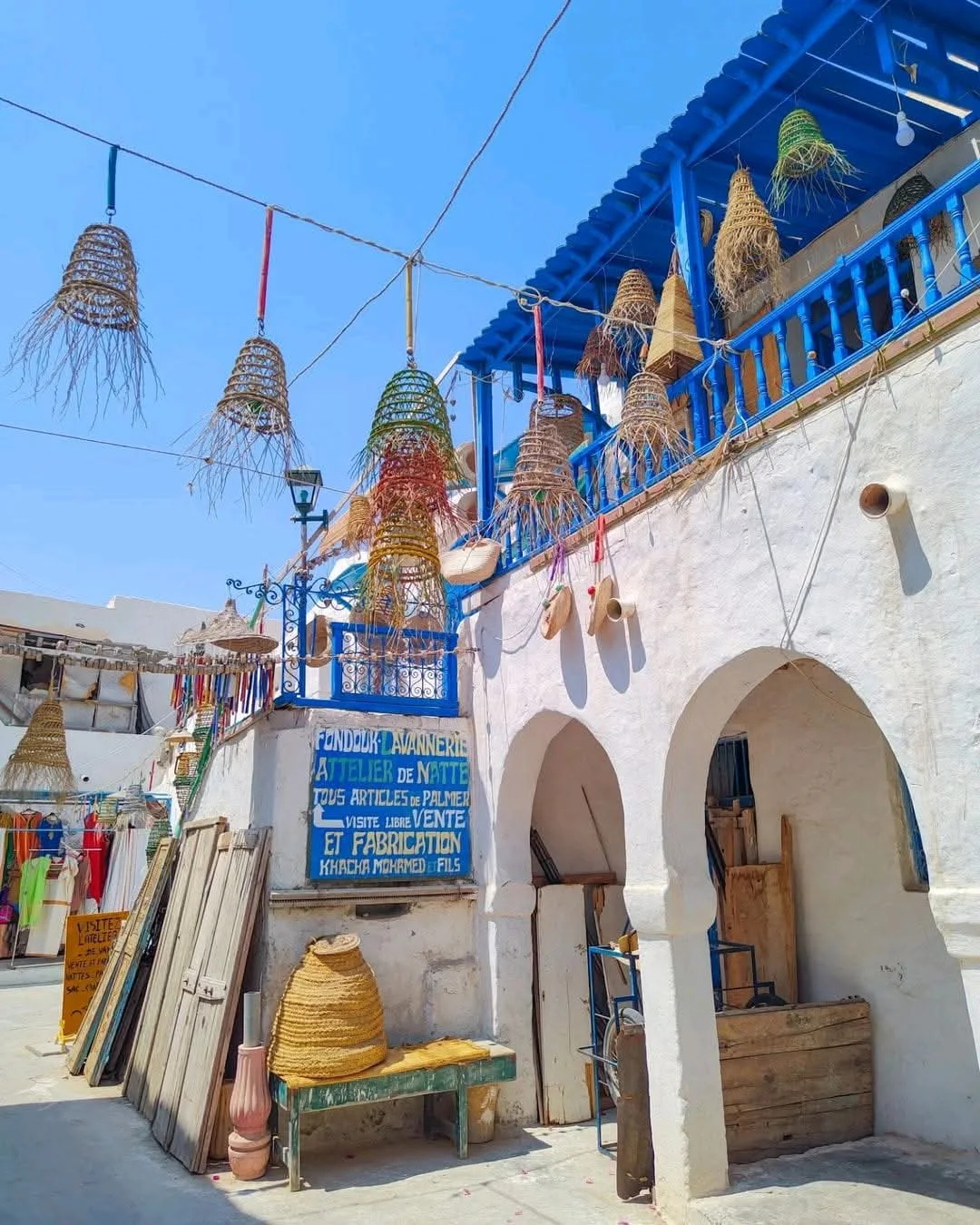
Covered alleys, souvenir shops, carpets, pottery, babouches, traditional clothing, jewelry. Magnificent architecture with arches and whitewashed vaults. But: inflated prices, vendors very (VERY) pushy, products often identical from one shop to another.
This is where organized tours drop you off. Fun for the atmosphere, but prepare yourself mentally.
**The Djerbian souk (Central market and periphery)**
Fruit and vegetable market: South of the souk. Where Djerbians do their shopping. Displayed prices, excellent quality, vendors who won’t harass you. Fresh dates, enormous pomegranates, homemade marinated olives.
Fish market: Right next door. Auction in the morning, ultra-fresh fish. Djerbians buy their fish here then have it grilled at one of the small restaurants around (Chez Azzedine, for example). You can do the same.
Spice souk: Also in the south. Honest prices, superior quality. Homemade harissa, bulk spices, mint tea, dried chili. Vendors let you taste without obligation to buy.
Jewelers’ souk: Jewel artisans who still make traditional pieces. Less touristy, authentic craftsmanship.
Local bakeries: Scattered around the souk. Fresh bread, makroud, ghraiba. Djerbians line up — follow them.
**My advice**
Do both. Browse the tourist souk for atmosphere and architecture (early morning if possible). But shop at the central market and spice souk. Superior quality, reasonable prices, more authentic interaction.


Negotiating Without Getting Ripped Off (Or Offending Anyone)
Negotiation is part of the game in Djerbian souks. But there are codes.
**The basics**
Initial price: The first price stated is usually 2 times the real price. Yes, really. It’s not to rip you off, it’s the starting point for negotiation.
Fair price: Aim for 40-50% of the initial price. For a carpet quoted at 100 TND, negotiate towards 40-50 TND.
Fixed-price shops: Some shops (especially outside the covered souk) display fixed prices. Respect them.
**The technique that works**
Show interest but not too much. “That’s nice, how much is it?”
Listen to the price without reacting. Three seconds of silence.
Propose 30-40% of the quoted price. “I was thinking more like XX dinars.”
He’ll refuse, explaining the quality, the work…
Raise slightly. But not much.
If he won’t budge enough, start to leave. “Thanks, I’ll think about it.”
Nine times out of ten, he’ll call you back with a better price.
**What NOT to do**
Don’t undervalue the work. If it’s hand-made craftsmanship, it’s worth something. Offering 5 TND for a carpet woven over weeks is insulting.
Don’t negotiate if you won’t buy. Negotiating for fun, then leaving without buying after getting the good price, is frowned upon.
Don’t compare to European prices. “But in France…” You’re not in France. Compare to Djerbian prices.
Don’t accept the first price if someone is harassing you. The most pushy vendors are rarely the most honest.
**Reference prices (ballpark figures)**
Decorated pottery: 10-25 TND
Leather babouches: 15-30 TND
Small carpet: 30-60 TND
Large carpet: 80-200 TND depending on quality
Olive oil (1L): 8-12 TND
Homemade harissa (jar): 5-8 TND
Djellaba: 25-50 TND
Divide by three if someone quotes you triple these prices.
Central market
At the fruit/vegetable/spice market, negotiation is minimal or non-existent. Prices are usually displayed and honest. You can ask for a small gesture on a large quantity, but it’s not the same game as at the tourist souk.


Local Codes You Absolutely Need to Know
A few cultural codes that make everything easier.
**Greetings**
“Salam Alikoum”: Hello. Use it when entering a shop, even if you don’t plan to buy.
“Bslema”: Goodbye. Always say goodbye, even if a vendor was a pain.
**Djerbian hospitality**
Djerbians are hospitable. A vendor might offer you mint tea. Accept if you have time — it’s a moment of exchange, not an obligation to buy.
If someone invites you to sit, chat, share something, it’s sincere. Hospitality is part of the culture. You’re not obliged to accept, but if you systematically refuse everything, you’ll miss out on nice encounters.
**What annoys Djerbians**
Photographing people without asking. Especially women. Ask first.
Entering a mosque without being Muslim. Houmt Souk’s mosques aren’t tourist attractions.
Negotiating aggressively. Negotiation should remain pleasant and respectful.
Walking around topless or in swim trunks away from the beach. Houmt Souk is a city, not a beach resort.
**Money**
Cash is king. Most souk businesses only accept cash. ATMs are on Habib Bourguiba Avenue (banks) or near the port.
Small change. Always have 5, 10, 20 TND bills. Nobody can change a 50 TND note for a 3 TND purchase.
Credit cards. Accepted at upscale restaurants, some hotels, a few large shops. But rely on cash.
**Visiting timing**
Friday: Prayer day. Respect this time. Avoid visiting near mosques between noon and 2pm.
Ramadan: During Ramadan, schedules shift. Many close during the day, reopen in the evening.
My Hour-by-Hour Optimized Schedule
Here’s how I’d organize a perfect day in Houmt Souk if I were advising a friend.
**7am-9am: Easy morning**
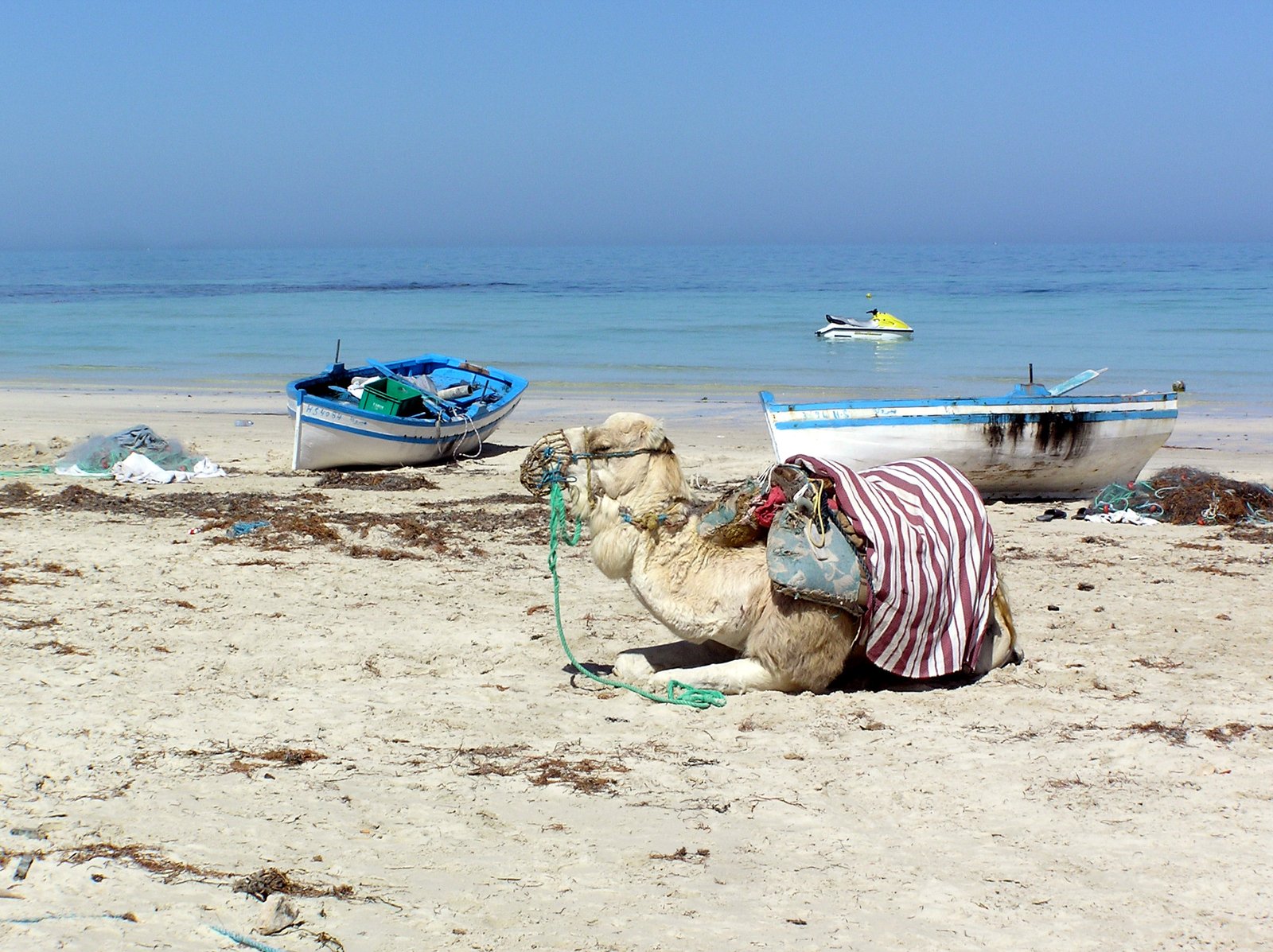
Coffee at a local café terrace near the port. Watch the city wake up. Fishing boats return, shopkeepers open up. Beautiful light for photos.
If you’re an early riser, walk the corniche to the fortress. Almost nobody at this hour.
**9am-1pm: Active exploration**
9am-10:30am: Central market. Fruits, vegetables, spices. Buy your dates, your harissa, your olive oil. Local atmosphere guaranteed.
10:30am-11:30am: Fish market. Watch the auction. If you feel like it, buy a fish and have it grilled on-site at a restaurant nearby. Or just observe the spectacle.
11:30am-1pm: Stroll through the tourist souk. At this hour, there’s already activity but it’s not yet crazy. Admire the architecture, negotiate your souvenirs if you feel like it. Or just wander for the atmosphere.
**1pm-4pm: Intelligent break**
Everything closes. Two options:
Option 1: Leisurely lunch at a nice restaurant (El Foundouk for the setting, Restaurant de l’Île for the traditional gargoulette if you ordered ahead, Haroun at the port…). Then café and siesta at your hotel or at a shaded café.


Option 2: Return to your hotel/beach. Houmt Souk is 10 minutes by car from the tourist zone.
**4pm-7pm: Second round**
4pm-5:30pm: Visit Borj El Kebir fortress. Fewer crowds in the afternoon, superb light for photos from the top of the ramparts. View of the port, sea, and the obelisk marking where the ancient Tower of Skulls stood.
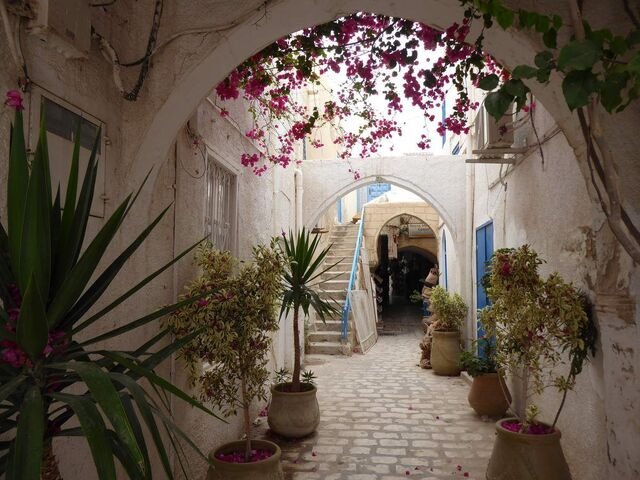
5:30pm-7pm: Wander the old town (Taourit and Ejjouamaâ sectors). White alleys, colorful doors, hidden patios. Almost no tourists at this hour. Meditative, authentic atmosphere.
**After 7pm: Djerbian evening**
7pm-8:30pm: Corniche stroll. Djerbian families come out for their walk. Peaceful atmosphere.
8:30pm-10pm: Dinner. Either at the port (Haroun, Dar El Houta), or downtown (La Braise, El Foundouk). Or head to Midoun/tourist zone for more options.
After 10pm: The city quiets down. Houmt Souk isn’t known for a bustling nightlife. Café terrace, pleasant conversation, then head back for rest.


The Must-Sees (But Not for the Usual Reasons)
Yes, you should see these places. But let me explain why you really should.
**Borj El Kebir Fortress**
All guides tell you to visit. They’re right. But not just to “see the sights”.
Climb the ramparts. Take your time. You have a 360° view: the fishing port to the north, the white city stretching south, the sea stretching endlessly, the islet with the marina.
To the west, the obelisk marks where the Tower of Skulls stood — 6000 skulls piled up after the 1560 battle. This tower was visible for almost 300 years before being destroyed. Try to imagine it.
The fortress itself was built, destroyed, rebuilt at least five times. Each layer tells a story of battle, conquest, change of power. Romans, Aragonese, Ottomans, Spanish, French — they all passed through here.
Practical info: Open 9am-5pm approximately (varies). Paid entry (a few dinars). Budget 30-45 minutes for a visit.


**Fish market and the auction**
The fish market isn’t just a “picturesque spot for photos”. It’s Djerba’s premier fishing port.
The technique of octopus fishing with terracotta jars (gargoulettes) is typical of Djerba. You see hundreds of jars stacked near the port? That’s what they’re for. Fishermen submerge them, octopuses hide inside, fishermen pull them up. Ancestral technique.
The fish sold here was caught this morning. Dorada, bass, red mullet, pageot, grouper (if you’re lucky), octopus, squid. The auction around 10:30am-11am is a spectacle itself — professional buyers (restaurateurs, fishmongers) bid at the auction, shouting loudly, in Djerbian dialect. You can’t understand everything, but the energy is infectious.
You can buy fresh fish and have it grilled at one of the nearby restaurants for a few extra dinars. It’s worth it.
**Marina (Pleasure port)**
The modern marina contrasts with the traditional fishing port. This is where excursions to Flamingo Island (Ras Rmel) depart.
These “pirate” boats (galliots) are admittedly kitschy. But the excursion is nice: cruise with music, sandbank stop, chance to see flamingos (not guaranteed depending on season), swimming. Fun atmosphere.
Otherwise, the marina is just pleasant for a late afternoon stroll. Cafés, ice cream shops, boats bobbing. Nothing extraordinary, but peaceful.


**Old town and its neighborhoods**
The true charm of Houmt Souk hides in the white alleys far from the tourist souk.
Taourit sector: Old neighborhood with traditional houses, whitewashed facades, blue or green doors. Timeless atmosphere.
Old fondouks: Caravanserais transformed into cafés, shops, or left abandoned. Particular architecture with interior courtyards. Look for El Foundouk (the one that became a restaurant/café/gallery) — superb.
Wander without a plan. Get lost. The alleys will always lead you back to a main street. It’s in these moments you discover real treasures: a secret patio glimpsed through a half-open door, a bakery where locals line up, a beautifully preserved old Djerbian house.


Conclusion: The Real Keys to Houmt Souk
Houmt Souk isn’t complicated if you know the codes.
Respect the Djerbian rhythm. The city operates 8am-1pm and 4pm-7pm. Adapt.
Park smartly. Port or periphery, then walk. Or take a taxi.
Negotiate with a smile. Aim for 40-50% of the initial price. Stay respectful.
Separate tourist from local. Tourist souk for atmosphere, central market for shopping.
Go early. Better light, fewer crowds, pleasant temperatures.
Get lost in the old town. Real treasures are off the beaten path.
Houmt Souk requires effort. It’s not an easy postcard. But when you understand how it works, when you find your rhythm, when you discover that little café where nobody goes, that alley where time stopped, that spice vendor who lets you taste ten varieties of harissa while chatting about everything and nothing — that’s when you understand why I’ve lived here for five years.
Now it’s your turn. Houmt Souk awaits you.